# IncNavierStokesSolver: Pressure field incorrect despite stable velocity field using Taylor-Hood Approximation on Polynomial order
**URL:** https://forum.nektar.info/t/incnavierstokessolver-pressure-field-incorrect-despite-stable-velocity-field-using-taylor-hood-approximation-on-polynomial-order/17
**Category:** Usage Support
**Created:** [July 16, 2026, 7:19pm UTC](https://forum.nektar.info/t/incnavierstokessolver-pressure-field-incorrect-despite-stable-velocity-field-using-taylor-hood-approximation-on-polynomial-order/17 "2026-07-16T19:19:46Z")
**Posts on this page:** 6
**Page:** 1
### Author:  [@yaso](https://forum.nektar.info/u/yaso)
#### Post date: [July 16, 2026, 7:19pm UTC](https://forum.nektar.info/t/incnavierstokessolver-pressure-field-incorrect-despite-stable-velocity-field-using-taylor-hood-approximation-on-polynomial-order/17/1 "2026-07-16T19:19:46Z")
Hello Dear Nektar forum, hope my message finds everyone well.
I have been working on a film-cooling hole nektar++ set-up case. I mainly followed the guidelines from Imperial front wing study and the user guide. I’ve run into a puzzling Taylor-Hood pressure issue that I’d appreciate some insight on.
**Case set-u p**
I started with a coarse linear mesh, has 200K nodes and 1million DOF at P=1. This mesh has one macro prism layer and uses NekMesh prism layer splitting to create the prism layers .
Channel U∞ = 10 m/s, with coolant supplied from a plenum at 0.1309 m/s to match a 10 m/s jet velocity at the hole. The geometry has two sharp features that make meshing difficult; since the bottom corner also has high gradients, I added a fillet there to avoid solver instabilities from skewed cel ls.
I use a RANS field to initialise start-up and start the solution from P=1. This calculation continued for 10 through-flows based on channel length (60D/Uinf; where D=0.00775 m and Uinf=10ms), just to make sure I have a stable starting point when increasing the polynomial order. (P= 1, CFL= 0.04, for testing purposes)
**The issue**
I then used part of the IFW condition xml file as a template to increase the polynomial order to P=2(NUMMODES=3) for velocity and leave the polynomial order at P=1(NUMMODES=2) for pressure, using a Taylor-Hood polynomial expansion. I tested 2 different variants of this.
Explicit form: (as shown in the my example following IFW below)
```auto
```
Secondly, I tested a compact form following the user guide as below;
```auto
```
I attached the full version of my condition xml file.
The solver can run with a stable CFL throughout the calculation. However unfortunately, I cannot obtain a meaningful pressure field (unphysical values) although the velocity field is showing correct time evolution.
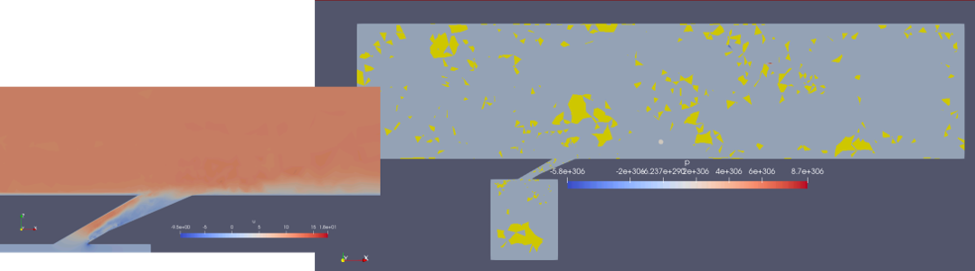
dt=10-7, CFL=0.04 (for testing purposes)
Example log output:
Writing: “cad3p\_p12\_dt107\_6599.chk” (0.105439s, XML)
CPU time for filter Checkpoint: 0.106312s
Percentage of time integration: 44.765 %
Total filters CPU Time: 0.10631 2s
CG iterations made = 13 using tolerance of 1e-09 (error = 3.52241e-10, rhs\_mag = 65.06 82)
CG iterations made = 51 using tolerance of 1e-09 (error = 9.66572e-10, rhs\_mag = 2.40845e +08)
CG iterations made = 45 using tolerance of 1e-09 (error = 9.95594e-10, rhs\_mag = 2.28485 e+08)
CG iterations made = 49 using tolerance of 1e-09 (error = 9.5522e-10, rhs\_mag = 2.1676 1e+08)
Steps: 65995 Time: 0.0065995 CPU Time: 0. 230819s
CFL: 0.0412955 (in elm t 77680)
CG iterations made = 13 using tolerance of 1e-09 (error = 3.52414e-10, rhs\_mag = 65.0671)
CG iterations made = 51 using tolerance of 1e-09 (error = 9.66698e-10, rhs\_mag = 2. 40845e+08)
CG iterations made = 45 using tolerance of 1e-09 (error = 9.9577e-10, rhs\_mag = 2 .28485e+08)
CG iterations made = 49 using tolerance of 1e-09 (error = 9.54988e-10, rhs\_mag = 2.16761e+08)
Steps: 65997 Time: 0.0065997 CPU Ti me: 0.233592s
In the case I don’t use Taylor Hood Approximation and set the polynomial order to P=2 for both velocity and pressure, I am able to capture the accurate evolution for both velocity and pressure fields. (P= 2, dt=10-7, CFL= 0.04)
Another detail is the DOF calculated using FieldConvert utility, which is 3million for both cases that using Taylor-Hood appx. and P=2 for both pressure and velocity. Since the pressure polynomial order is lower with Taylor-Hood appx., I would have expected the total DOF to be lower accordingly.
I had several tests to overcome the issue such as initialising pressure to 0 at the start-up(s), testing different tolerances for pressure iterative solver or testing Taylor Hood appx with simplified case; a channel flow domain where the jet is defined as a BC at the wall to isolate the effect of the mesh difficulties, however these also resulted s imilarly.
- I would be very happy to have a bit more understanding of the Taylor-Hood approximation, and how I should be calculating number of points for different element types in case there are any mistakes in my de finitions.
- Are there any specific pressure boundary conditions should I be using at the walls for this f ormulation?
- I was also wondering whether the pressure is obtained through an iterative corrector loop within each timestep (as in PISO-type schemes) or reconstructed directly from the predicted velocity field via a single Poisson solve per step (fractional-step) to get a better understanding on velocity pressure coupling and how sensitive that reconstruction is to initialising pressure to 0 at start-up.
Any pointers or advice would be highly appreciated and thank you very much for your times and kind support.
> **Summary**
>
> This text will be hidden
\
```auto
IMEX
1
TimeStep = 0.0000001
NumSteps = 150000
IO_InfoSteps = 1
IO_CFLSteps = 1
Re = 5100
Kinvis = 0.0000149
SVVCutoffRatio = 0.3
SVVDiffCoeff = 1.0
u
v
w
p
C[11]
C[3]
C[5]
C[7]
C[9]
C[2,12,14,15]
cad3p_p12_dt107
10
```
---
### Author:  [@hwustenb](https://forum.nektar.info/u/hwustenb)
#### Post date: [July 24, 2026, 10:39am UTC](https://forum.nektar.info/t/incnavierstokessolver-pressure-field-incorrect-despite-stable-velocity-field-using-taylor-hood-approximation-on-polynomial-order/17/2 "2026-07-24T10:39:23Z")
Hi yaso,
many thanks for the detailed setup.
I have a few ideas what might be the issue:
- The velocity correction scheme requires a consistent pressure boundary condition for higher-order time accuracy, see section 3.4.6.2 of the User-guide. Set all pressure Neumann condition to use ‘USERDEFINEDTYPE=“H”’. This might already solve the issue.
- The preconditioner `FullLinearSpaceWithLowEnergyBlock` is not heavily used and hence tested. Consider using a diagonal preconditioner for testing.
- The Taylor-Hood and equal-order approximations can become unstable at very small time step sizes consider using a time step aiming for a CFL estimate of CFL ~= 0.3
A few more ideas that are not directly related to your issue:
- Did you try a higher polynomial order that is NUMMODES \> 3?
- If you want to try larger time step sizes, you could also use the implicit velocity correction scheme by replacing `VelocityCorrectionScheme` with `VCSImpliict` and changing the iterative solver to `GMRES`.
Let me know if this helps.
Best wishes,
Henrik
---
### Author:  [@alexander.schukmann](https://forum.nektar.info/u/alexander.schukmann)
#### Post date: [October 2, 2026, 7:58am UTC](https://forum.nektar.info/t/incnavierstokessolver-pressure-field-incorrect-despite-stable-velocity-field-using-taylor-hood-approximation-on-polynomial-order/17/3 "2026-10-02T07:58:35Z")
I had a similar issue and found it to be caused by the checkpoint filter when used in combination with the T-H approx. Switching to IO\_CheckSteps solved it for me with version 5.7.0.
Edit: There is a more recent post mentioning this issue
[https://forum.nektar.info/t/checkpoint-filter-fails-with-mixed-expansion-order/21?](https://forum.nektar.info/t/checkpoint-filter-fails-with-mixed-expansion-order/21)
---
### Author:  [@gaoak](https://forum.nektar.info/u/gaoak)
#### Post date: [October 3, 2026, 4:58am UTC](https://forum.nektar.info/t/incnavierstokessolver-pressure-field-incorrect-despite-stable-velocity-field-using-taylor-hood-approximation-on-polynomial-order/17/4 "2026-10-03T04:58:06Z")
Yes, the solver is all right. Only the output pressure field is broken. I asked gpt, and it said the checkpoint filter does not set the expansion information correctly.
---
### Author:  [@yaso](https://forum.nektar.info/u/yaso)
#### Post date: [October 6, 2026, 1:36pm UTC](https://forum.nektar.info/t/incnavierstokessolver-pressure-field-incorrect-despite-stable-velocity-field-using-taylor-hood-approximation-on-polynomial-order/17/5 "2026-10-06T13:36:28Z")
Dear All,
This is very helpful, thank you very much for your time and replies on the issue.
@hwustenb thank you very much also for the recommendations, these were also very helpful for improving the set-up!
I was wondering if the issue was fixed on the new version, nektar++ v5.10?
Thank you very much for your time and support once again
---
### Author:  [@hwustenb](https://forum.nektar.info/u/hwustenb)
#### Post date: [October 7, 2026, 7:03am UTC](https://forum.nektar.info/t/incnavierstokessolver-pressure-field-incorrect-despite-stable-velocity-field-using-taylor-hood-approximation-on-polynomial-order/17/6 "2026-10-07T07:03:19Z")
Hi,
we discovered an issue with the checkpointing for Taylor-Hood expansions. There is a merge request open for fixing this on the [gitlab](https://gitlab.nektar.info/nektar/nektar/-/merge_requests/2792). Potentially this is the issue both of you encountered.
Best wishes,
Henrik